
LCD vs LED Displays
Digital displays now sit at the heart of transport hubs, retail environments, and out-of-home advertising networks.
Once, the choice between LCD and LED was straightforward: LCD for indoor, close-viewing applications; LED for large outdoor canvases. That separation has all but disappeared.
The two technologies have converged, competing directly in the same spaces, at similar price points, with overlapping performance capabilities.
For integrators and resellers, that means the wrong specification can quietly erode margins, shorten refresh cycles, and undermine the end-client experience.
Getting this decision right has never mattered more.
How the Market Got Here
For most of the last two decades, LCD and LED had clearly defined roles.
LCD dominated indoor, close-viewing environments. LED owned large-format outdoor applications. That separation no longer exists.
When the first small-format 57-inch LCD screens were installed on the London Underground in 2008, LED simply wasn’t an option.
By the mid-2010s, LCD had matured into a stable platform, with 75-inch and 85-inch displays becoming common. Meanwhile, LED pixel pitches continued to shrink, from P10+ to P3, then P1.5 and below.
As resolution improved and pricing dropped, LED began entering spaces that had traditionally belonged to LCD.
Today, both technologies compete across totems, digital posters, platform displays, and small-format outdoor applications. The boundaries are gone.
The Cost of Getting It Wrong
A real example.
A transport operator specified LCD for an outdoor platform display. Within three years, moisture ingress and direct sunlight exposure forced a full replacement.
A more robust specification, incorporating appropriate enclosure design, thermal management, and serviceable components, would have significantly reduced lifecycle costs and extended the display’s operational life.
What Actually Drives the Right Specification
When LCD and LED compete within the same footprint, six key factors drive the decision.
Understanding each one, and how the technologies compare, is the difference between a well-deployed network and an expensive mistake.
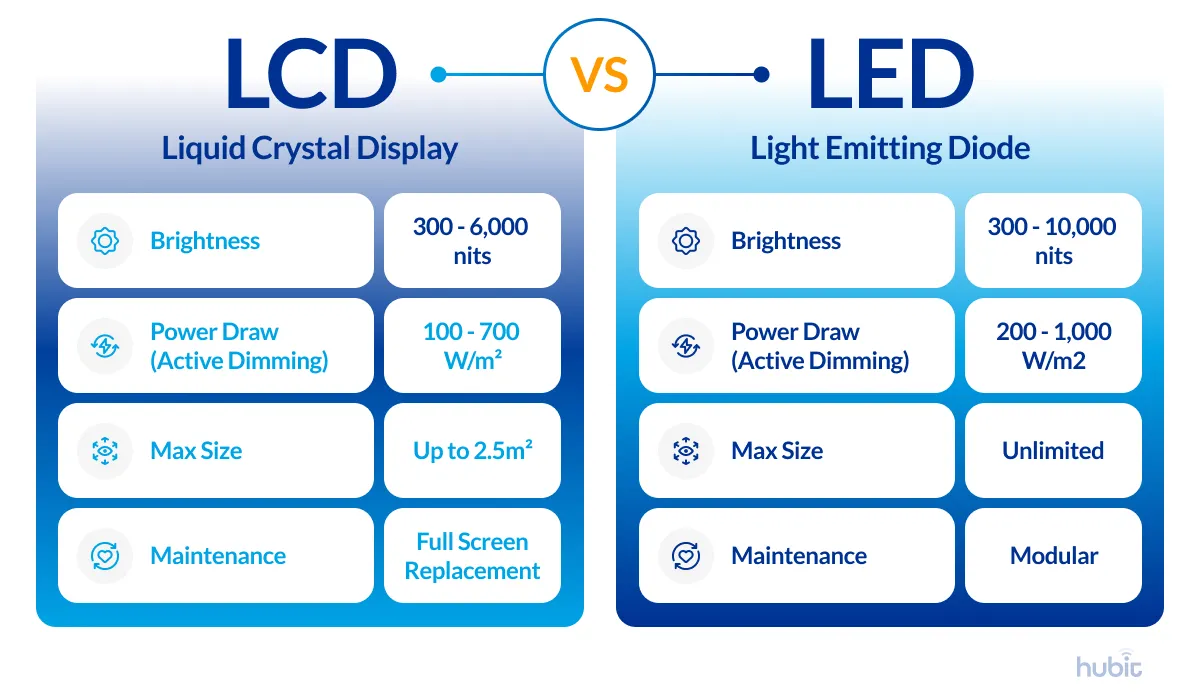
The table below shows how each factor plays out across both technologies:
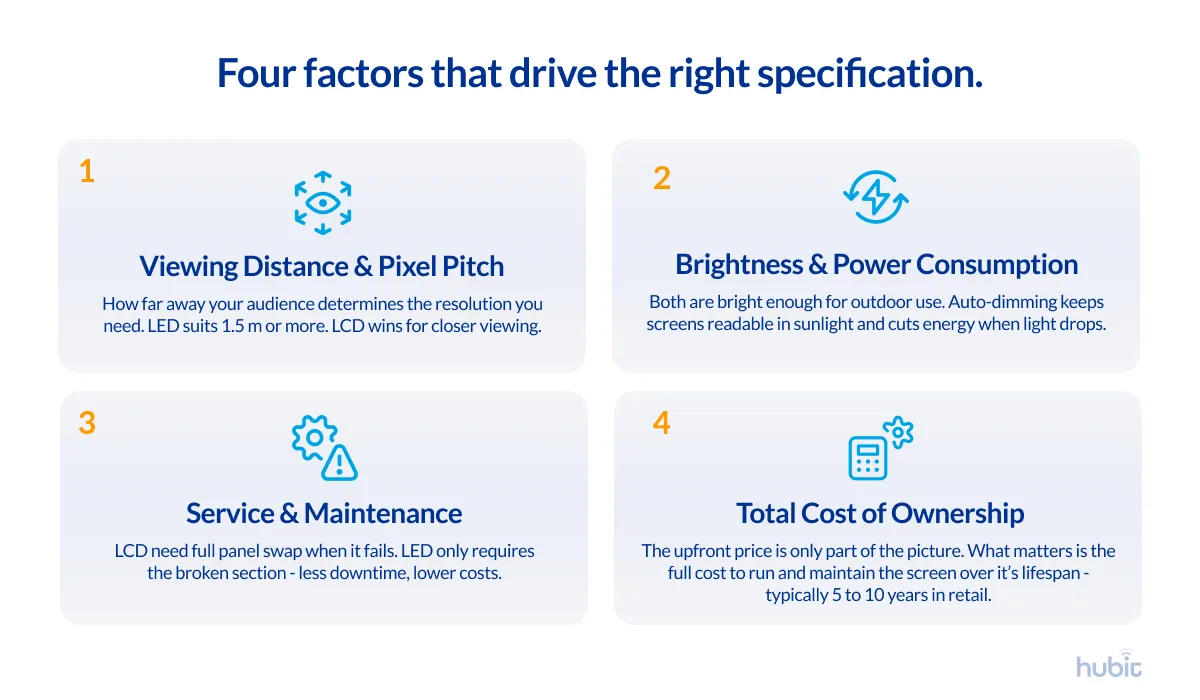
Neither technology wins outright.
The application determines the answer. Specifying the wrong technology drives higher operating costs, increased maintenance burden, and reduced performance over time.
Three mistakes come up time and again: prioritising upfront cost, overlooking viewing distance, and underestimating maintenance requirements and realistic operating lifetimes.
Any one of them will add cost over time. All three together can make a network difficult to maintain within five years.
What Your Audience Actually Sees
Specification decisions are made in spreadsheets. The results play out on screen.
LED’s superior contrast, brightness, and dynamic image performance make it the stronger choice for fast-moving video, HDR content, and high-ambient-light environments where impact matters. Think full-motion advertising, wayfinding in bright transport hubs, or any application where the content needs to stop someone in their tracks.
LCD’s colour accuracy and fine detail make it better suited to text-heavy content, dashboards, and data displays — anywhere precision and legibility at close range are more important than visual impact.
In practice, this is often the most overlooked part of the specification conversation. The technology has to match not just the environment, but what the screen is actually being asked to display.
Making the Right Call
The convergence of LCD and LED is a market reality, not a temporary trend.
Navigating this decision, weighing viewing distance, environment, lifecycle expectations, and total cost of ownership — is what separates a successful deployment from an expensive one.
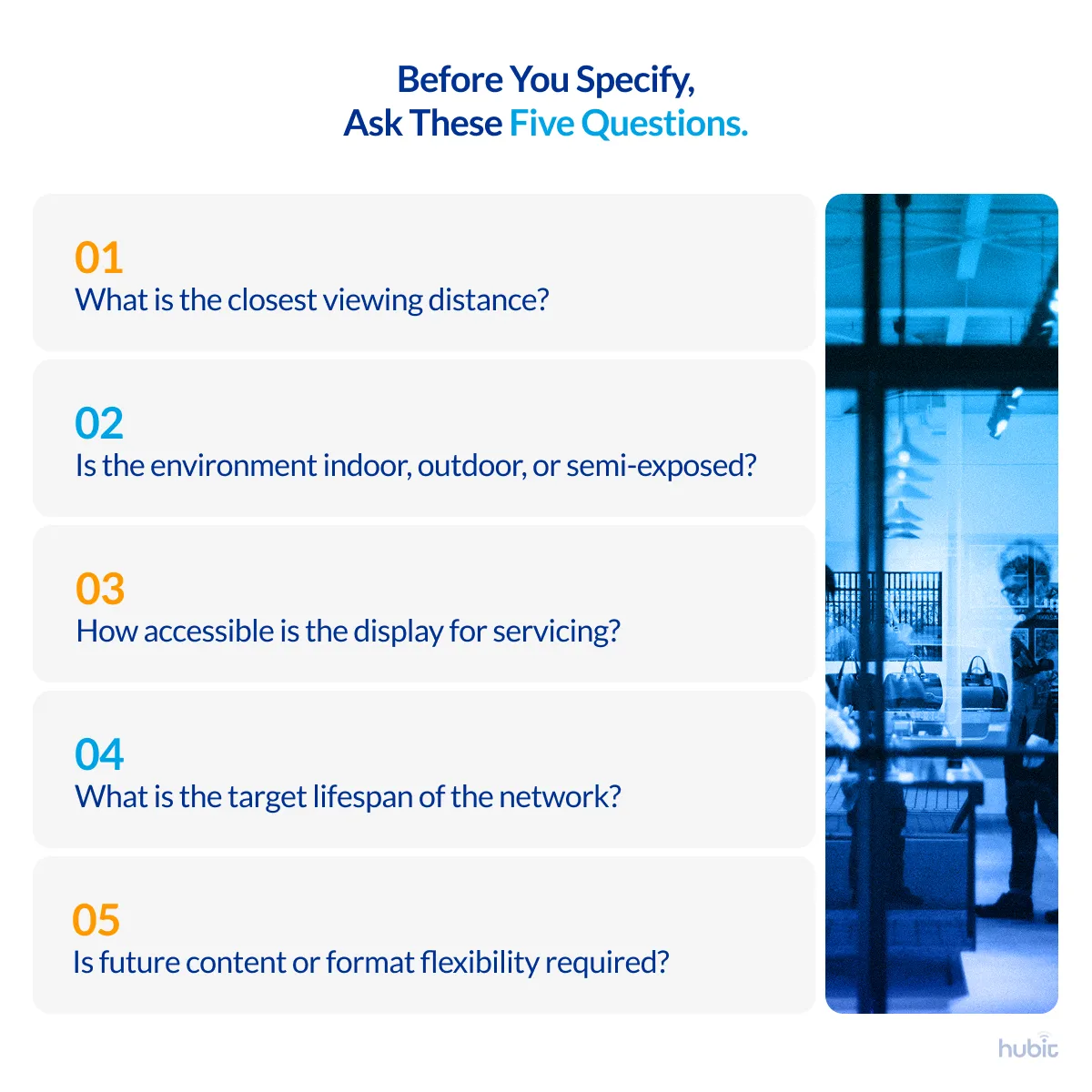
Before You Specify, Ask These Five Questions
At Hubit, we understand the strengths and limitations of both technologies and can help you specify with confidence, focusing on the best fit for your application.
With over 25 years of supply chain expertise and partnerships with trusted LED and LCD manufacturers, we match the right solution to the right environment, with serviceability, future-proofing, and long-term performance built in from day one.
Every display project has different requirements. Whether you’re deploying a transport network, retail estate, or digital advertising platform, Hubit can help you select the right technology for long-term performance and value.
Navigating an LCD vs LED decision? Get in touch with our team below.
Similar stories
Closed-Loop Attribution for Digital Signage: How Vision Analytics Is Changing the Game
What you’ll learn in this article
What “closed-loop attribution” means for digital signage, and why it matters
How vision analytics and computer vision turn screens into measurable media
The difference between “play”-based and “view”-based advertising metrics
How edge decision-making lets screens change content in real time based on who’s watching
Which industries benefit most: retail, corporate, and QSR
How Navori’s Qompose platform and Stix3800 player bring this to life
Digital Signage Has Been Around for 30+ Years. Here’s What’s Changing
Digital signage as a technology has been around for over 30 years. You’ll see it in countless environments and use cases. From digital out-of-home (DOOH) advertising to quick-service restaurant (QSR) digital menu boards. Across all of these, digital signage plays a critical role: delivering information to an audience in an engaging way, with the ability to rapidly deploy new messages at a global scale.
For years, digital signage has simply been seen as an upgrade to traditional print media, swapping static posters for motion content, and removing the logistical headache of updating hundreds of physical displays every time a message needs to change.
But that’s no longer where the story ends.
In plain terms, closed-loop attribution means connecting what a screen showed to what happened afterward: tying viewership data captured by the sensor back to a measurable business outcome, like a sale or an engagement rate, so a screen’s content can be proven, and then improved, rather than just tracked as having played.
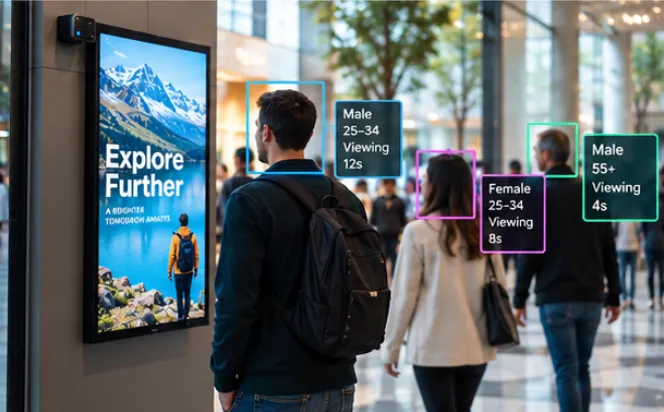
The Next Step in Digital Signage Intelligence: Vision Analytics
As technology advances, the next generation of digital signage intelligence is arriving: vision analytics powered by computer vision.
Vision analytics unlocks three major capabilities for digital signage networks:
A clear understanding of your audience in front of the screen
Proof of viewership for your digital signage content
The ability to “close the loop” – understanding screen impact, measuring results, and making content changes based on real data
Watch the video here: https://www.youtube.com/watch?v=pws5OMK2ptk
The YouTube Analogy
The clearest comparison is a platform most marketers already know well: YouTube.
Within YouTube Analytics, you can see how successful your content is, where viewers drop off, how long they engaged, and much more.
Vision analytics brings that same level of insight into the physical world, applying digital-media-style measurement to real-world screens.
How Hubit and Navori work together to create your ideal solution.
Navori provides the software, it handles content delivery, scheduling, intelligence through the Qompose platform. Hubit is an approved distributor of all Navori products, and also independently supplies and specifies the commercial display screens to complete the solution.
In practice, Hubit sources and specifies the right combination of Navori software, player (external or built-in) alongside display hardware specific to a client’s requirements, so that content flows reliably through Navori’s Qompose platform without adding extra hardware complexity. The goal is to bring the right screens, player, and CMS together into a single, cohesive retail-ready solution.
How Vision Analytics Works on a Digital Signage Network
Using the Qompose measure module, a small Optical Sensor is installed next to your screen and connected to your Stix3800 digital signage player. This sensor does not identify individuals and follows GDPR compliancy.
As an audience moves closer to the Optical Sensor, the system detects key metrics in real time: Number of individuals, length of stay, and attention span.
Pairing an optical sensor with a digital signage player unlocks two major capabilities:
- Edge Decision-Making
Want specific content to launch based on who’s actually standing in front of the screen? With Qompose, you can schedule triggered content changes that respond to the audience detected in real time. - Proof of Content Delivery
Beyond edge triggering, this technology gives you a far clearer picture of total viewership. In the DOOH sector, cost-per-advertisement has traditionally been measured by “plays” – the number of times an ad ran on screen. With vision analytics, advertisers can shift to charging based on “views” – the number of people who saw the ad. That’s a much more accurate measure of impact and value.
Who Benefits from Vision Analytics in Digital Signage?
Advertising is the obvious use case, but the impact reaches far beyond DOOH:
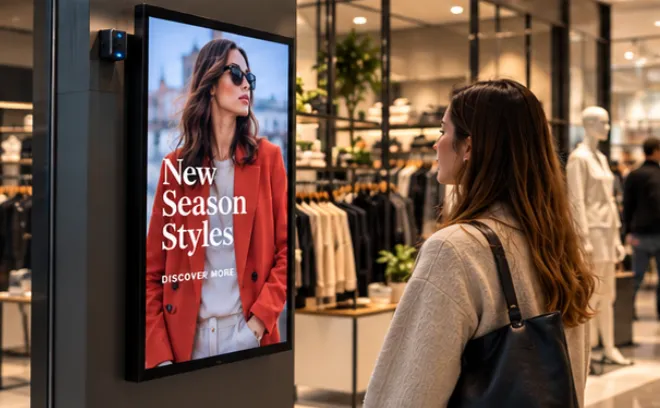
Retailers: Improve ROI on digital signage screen time by scheduling the right content, at the right time, for the right person in front of the screen.
Corporate spaces: Corporate screens aren’t usually used for advertising, but they do depend on compliance. Vision analytics helps confirm that critical internal messages were actually seen, and reports back on employee engagement with that content.
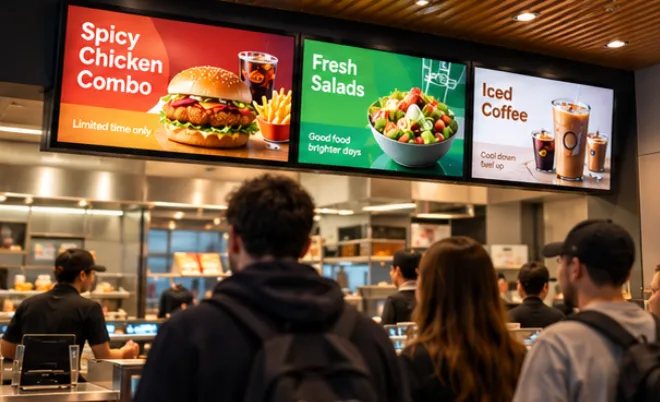
QSR (Quick-Service Restaurants): Vision analytics doesn’t stop at audience count and view time. With the right hardware, it can also register demographic details such as age and gender. That means content can be tailored to a specific target audience, helping boost sales of promoted items or move high-stock inventory faster.
Closing the Loop: How Navori Labs Brings AI Into the Picture
With new AI capabilities from Navori Labs built into the Qompose platform, closed-loop attribution finally becomes possible for digital signage networks.
By combining vision analytics with the Stix3800, screens can understand audience context, age, gender, interest, and view time and use that context to make real-time content decisions at the edge, directly on the Stix device rather than in the cloud.
That data then reports back into the Qompose platform for analysis. Retailers can combine this with their own POS or loyalty data to close the loop.
This gives customers the ability to make an informed decision on content that should play, review the audience data and compare this to increased sales of promoted products and make changes to improve sales uplift.
Want to learn more about vision analytics for digital signage?
Visit Navori.com to explore the Qompose platform.
Learn More